Happy Hens, Happy Life
4 Hens, 1 Anxious Dad, & a Lesson in Chicken Keeping

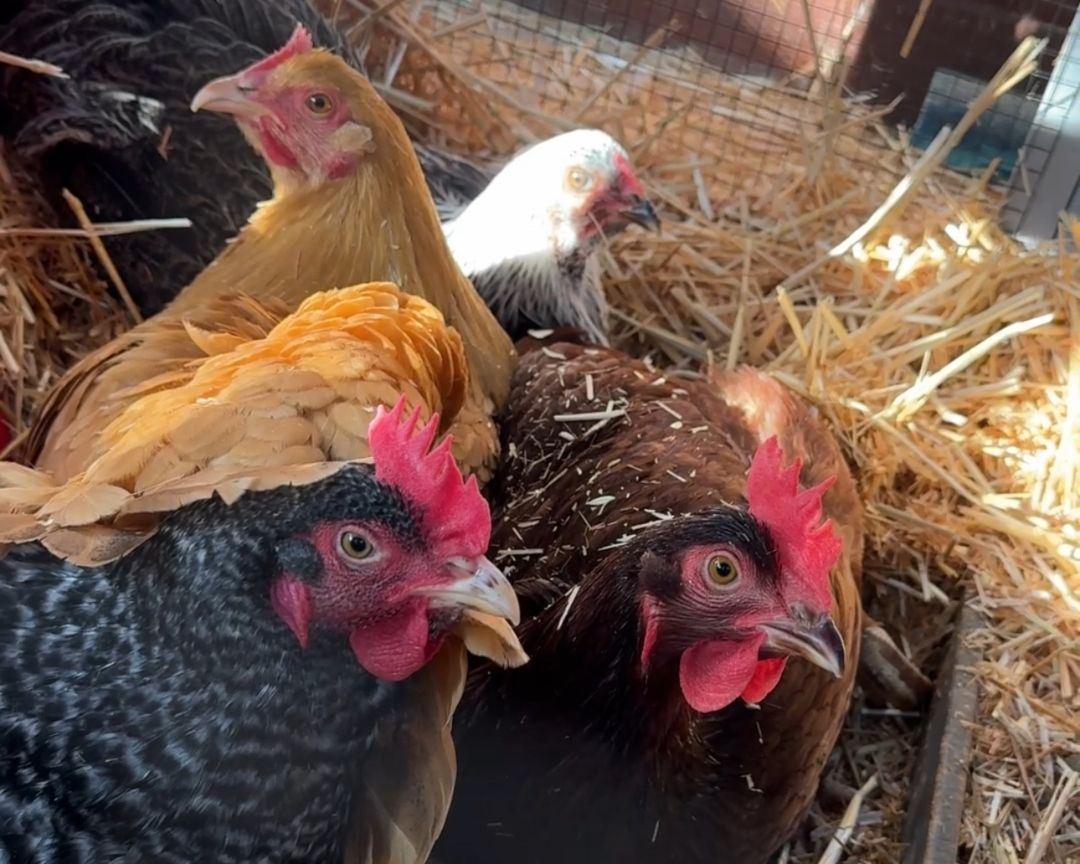
When my wife and I got “the girls,” as she calls them, I didn’t have any idea the amount of physical work that goes into raising chickens, nor did I understand the multifarious health risks chicken owners face.
We bought the girls at a local feed store when they were five days old, and the guy who sold them to us, the feed store’s owner, said the main thing to watch out for was “pasty butt,” which is when the chicks’ vents become clogged with their own feces. The condition is fatal, but preventable with vigilance and a wet paper towel. I must have cleaned the girls’ vents out a dozen times a day. I felt as though I were a pesky, overbearing hover-parent, one of those paranoid control-freaks who puts his kid on a leash at Disneyland, but if the girls were going to live, they needed that level of parental obsession.
During those nervous first few weeks, the girls lived in our bathtub, which we’d lined with wood shavings and other accoutrements (water bowl, feeder) from the “Chick Starter Kit” we bought at the feed store.
To keep the girls warm, we clamped a heat lamp to the tub faucet, a few feet above the shavings. The girls loved to huddle under it, but I was terrified the lamp would fall and start a fire. I had nightmare visions of burning the girls alive as a prelude to burning the house down, and my anxiety got so bad that my wife went online and ordered a fireproof brooder to replace the lamp. But I worried about the brooder, too, because it resembled a toy picnic table. A few pieces of plugged-in plastic, I thought, weren’t enough to keep the girls warm, and I became convinced that instead of immolation, they were going to die from exposure.
It didn’t help that I’d often find the girls face-down in their feeder, or on the bathtub floor. I always thought they were dead when I found them, but as anyone who’s raised chicks knows, that’s how they sleep. I never got used to it, so whenever I’d find them looking dead, I’d wake them up. They’d respond with noises that bordered on resentment, but that was easier to deal with than thinking they were gone, so I kept waking them up.
Fortunately, the girls outgrew their death-sleep phase after about a month. Almost immediately, though, they developed an even more frightening habit: launching themselves at the bathtub’s sliding glass doors. I couldn’t bear the sight or sound of their little chicken heads and wings against the glass, so I opened the tub doors and let the girls have the run of the bathroom — a huge mistake, for they began roosting on the toilet and sink, and their poop, which seemed to increase in stink and size with each defecation, was suddenly everywhere.
I didn’t know what to do, so I went back to the feed store and asked the owner for advice. When I told him the girls had taken over the bathroom, he looked at me with pity and disbelief.
“I’ve got two words for you,” he said: “Water tank.”
He gestured toward a big rubber tub, about six feet long and three feet deep, a few feet from the register.
“Throw your chicks in there,” he said, “and put some chicken wire over the top. That’ll solve your problems.”
“I don’t have any chicken wire,” I said, an admission that seemed to offend him even more than the girls’ conquest of the bathroom. He sighed and cleared his throat:
“The tank’s 80, but if you pay cash, I’ll throw in some wire.”
80 dollars seemed pricey for a large piece of rubber, chicken wire included or not, but I was desperate, so I bought the tank on the spot. It was a serious hassle getting it in and out of my Toyota Corolla, but once I got the tank home and the girls settled inside (my wife and I moved them into our spare bedroom), I didn’t care how much it cost: I would have paid twice as much for the cleanliness and order the tank restored.
Instead of worrying about the girls’ imminent death, or that the bathroom was becoming uninhabitable, I spent the early tank days in a folding chair, serenely watching the girls eat and drink and sleep. They seemed comfortable, and for the first time since we’d brought them home, I wasn’t on the verge of an anxiety attack.
My newly bought peace didn’t last long. The girls grew rapidly in the next few weeks, and I started to worry they’d hang themselves on the chicken wire, which they could suddenly reach with their beaks when they jumped. I removed the wire, but immediately, the girls jumped out of the tank and started exploring the spare bedroom. Once they were out, they refused to go back into the tank.
The breaking point came when our labradoodle, Mr. Harrison, stopped by to say hello. Instead of replying with her usual curious, semi-affectionate groan, Little Cinnamon clucked in a frenzy and pecked Mr. Harrison on the snout. Mr. Harrison jumped backwards, into my arms, and whelped, but as I was comforting him, Little Cinnamon charged and clucked and pecked at me to go away, too.
Again, I didn’t know what to do, so after I calmed Mr. Harrison down and wrangled Little Cinnamon into the tank, I went back to the feed store and asked the owner for more advice.
“They think you’re a rooster,” he said. “Start acting like one.”
“What would a rooster do in my situation?”
“Kick them out of the house,” he said sternly.
It was a challenge, moving the girls from the tank to the backyard. We’d already set up a two-story coop for “six to eight chickens” on our patio, but when we moved the girls into it, the space seemed insultingly small. They were all cramped together, wing-to-wing, groaning and clucking all day long. I couldn’t bear their discomfort, so I went online and ordered a 6-foot extension that accommodated “12 to 14 chickens.”
It was an excruciating two-week wait for the extension to arrive. The girls started fighting and pecking at each other, and they pecked at me whenever I came near, so it was a major relief when the extension finally arrived, and the girls were happy again.
That was spring, when the Southern California weather was cool and temperate. But then summer came, and triple-digit temperatures made the girls pant and droop their wings, both signs of heatstroke. I started to worry again, so I went back on the internet and bought an “outdoor air conditioner” (really a glorified swamp cooler) and two outdoor fans. I put the air conditioner between the fans and ran them all on high, day and night, through the summer.
My wife says the setup is “bougie,” and although I recoil at the word, I suppose an air conditioner for backyard chickens is a luxury. But I don’t see what the alternative is. If the girls overheat, they’ll die. That’s what the feed store owner told me, and when I asked him what to do about it, he handed me a few packets of a product called “Save-a-Chick” and said: “Put this in their water. The strong ones’ll live.”
Whatever it does to my reputation at the feed store, I refuse to subject the girls to such brutal Darwinian strife. Besides, their life in the backyard is already dangerous enough. We live in Lemon Grove, a small city south and east of San Diego, where the houses are on plots of old farmland. The soil is rich, but much of the area is still wild, so predators are everywhere — hawks, coyotes, raccoons, possums.
When the girls moved outside, I considered buying a shotgun, but my wife said it was a bad idea, so I compromised and bought a BB gun at the local Walmart instead. The salesman was a friendly, tattooed fellow. He asked me what the BB gun was for, and I said, “Predators.”
“This ain’t gonna kill nothin’,” he said, squinting at the oblong package.
I never found out if he was right. I couldn’t bring myself to shoot anything in our backyard. For the first few months, I kept the loaded BB gun next to the typewriter, a few feet from the coop, but whenever a hawk or coyote came around, I chased it away with an aluminum baseball bat, which I also kept next to the typewriter. When the girls saw me out on the grass, swinging the shiny aluminum at their attackers, they clucked with gratitude and pride. Then I was glad I didn’t use the BB gun or, God-forbid, a shotgun. I don’t think shooting a predator has the same natural luster as threatening to beat it senseless.
Eventually, my nervous system adjusted to the threats in the bushes and the sky, and I got more comfortable taking the girls out into the backyard without the bat.
Now, every day at sunrise, they race through the coop door and dig for worms in the wet grass. Little Cinnamon leads the way. Pepper follows clumsily and sometimes sneaks a worm from her beak, whereupon Little Cinnamon viciously pecks at Pepper’s neck. Salsita doesn’t usually get involved, but since she’s been molting, she’s attacked Pepper a few times. Then Paprika, alpha of the flock, puts Salsita in her place and takes the stolen worm for herself.
After they’ve had their fill and romped around the yard for a few hours, the girls stretch out in front of the air conditioner and nap — all except Little Cinnamon, who goes back to the coop to lay her egg. She’s up there now, groaning and clucking tomorrow’s breakfast into being. Her groans and clucks overpower the typewriter clacks, but I don’t mind. It’s a soothing soundtrack, a reminder of the primal, essential nature of the man-chicken relationship.
Or as the feedstore owner says: “Happy hens, happy life.”
About the Author: Joshua Hall is a lecturer in the Department of Rhetoric and Writing Studies at San Diego State University, where he has taught since 2007. His essays have recently appeared in Sport Literate, Bridge Eight Press, and the Los Angeles Review of Books.
Tags:Hot Topics











Chicken Whisperer is part of the Catalyst Communications Network publication family.